
The AIBIP Methodology
The Industrial Intelligence Journey
Building the Foundation for Sustainable Industrial AI
Industrial AI Is Not The Starting Point
Artificial Intelligence has become one of the most discussed technologies in modern manufacturing. Organisations are eager to automate decision-making, improve operational efficiency, predict failures before they occur, and capture valuable knowledge that would otherwise remain locked within experienced personnel.
However, many Industrial AI initiatives fail to deliver meaningful business value—not because AI itself is incapable, but because the operational environment is not yet prepared to support intelligent decision-making.
Industrial AI requires far more than data.
It requires context.
It requires operational knowledge.
It requires structured business rules.
It requires trustworthy information.
Without these foundations, AI systems may generate technically correct answers that are operationally incorrect, recommend actions that violate business constraints, or overlook decades of engineering experience that were never documented.
At AIBIP, we believe that Industrial AI is not a product that can simply be installed.
It is the result of systematically preparing an organisation’s operational intelligence.
This philosophy forms the foundation of every AIBIP engagement.
The AIBIP Philosophy
Every successful Industrial AI implementation follows a similar journey.
Before intelligent systems can reason, recommend, or automate decisions, an organisation must first establish a structured operational environment where data, processes, engineering knowledge, and business objectives are connected into a coherent intelligence ecosystem.
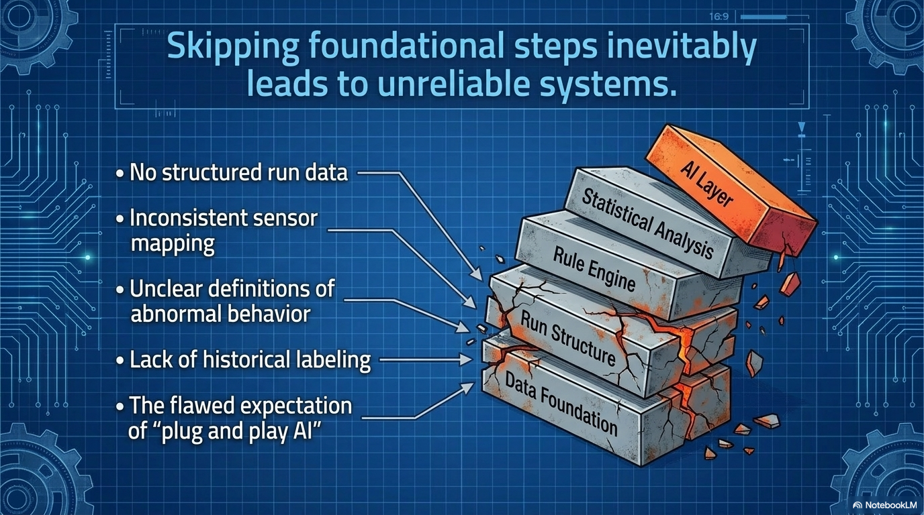
Rather than treating AI as the first step, AIBIP positions AI as the final stage of a carefully planned transformation.
This ensures that every AI recommendation is grounded in operational reality rather than statistical probability alone.
Our methodology focuses on transforming fragmented operational assets into a structured intelligence platform that both humans and AI can understand, trust, and continuously improve.
The Industrial Intelligence Journey
Every organisation begins at a different stage of digital maturity.
Some possess modern manufacturing systems but lack integration.
Others have abundant operational data but limited visibility.
Some have excellent engineers whose expertise exists only in their experience rather than documented procedures.
The objective of the AIBIP methodology is to progressively transform these disconnected assets into Industrial Intelligence.
The journey consists of five progressive layers.
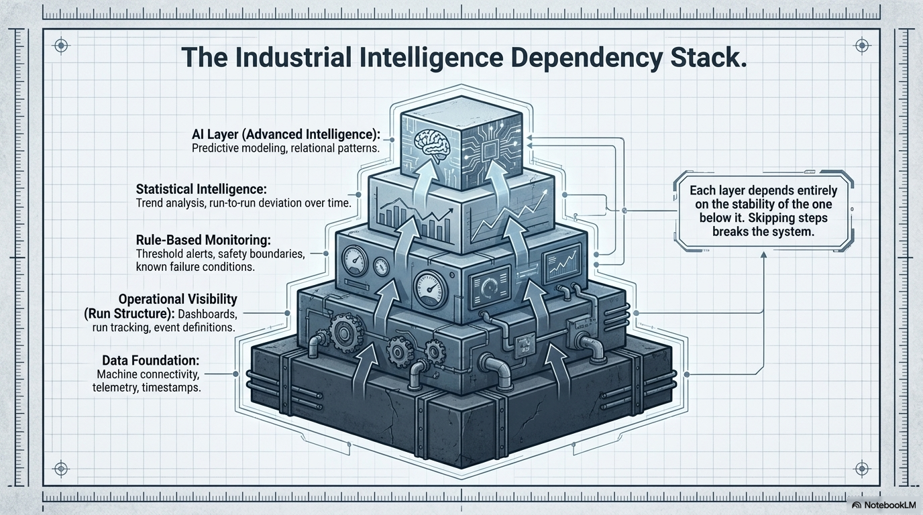
Layer 1 — Data Foundation
Reliable intelligence begins with reliable data.
The first stage focuses on identifying, collecting, organising, and validating operational information across the organisation.
Typical sources include:
- Machine telemetry
- PLC and control systems
- SCADA systems
- Manufacturing Execution Systems (MES)
- Enterprise Resource Planning (ERP)
- IoT sensors
- Quality inspection systems
- Laboratory measurements
- Maintenance records
- Energy monitoring
- Production reports
- Existing spreadsheets
- Manual operational records
The objective is not simply to collect more data.
The objective is to establish trusted, consistent and meaningful operational information that accurately represents how the business operates.
Without reliable data, every subsequent layer becomes increasingly unreliable.
Layer 2 — Operational Run Structure
Data alone rarely explains how an organisation operates.
Operational intelligence requires understanding the relationships between machines, production processes, products, recipes, operating procedures, quality requirements, maintenance activities, and business objectives.
During this phase, AIBIP structures the organisation’s operational landscape by documenting workflows, dependencies, process boundaries, operational responsibilities, and engineering knowledge.
This creates a common operational language across departments and provides the structure necessary for consistent decision-making.
The result is an organisation that understands not only what happened, but also how its operations function as an interconnected system.
Layer 3 — Rule-Based Monitoring
Industrial operations have always relied on rules.
Machines have operating limits.
Recipes have tolerances.
Quality specifications define acceptable ranges.
Maintenance schedules establish servicing intervals.
Safety procedures define operational boundaries.
These rules represent decades of accumulated engineering knowledge.
Rather than allowing these rules to remain hidden inside documents or individual experience, AIBIP transforms them into structured operational logic that can be monitored continuously.
Rule-based monitoring enables organisations to detect operational deviations immediately, standardise decision-making, reduce unnecessary downtime, and improve operational consistency.
More importantly, these rules provide the operational boundaries that future AI systems must respect.
Layer 4 — Statistical Intelligence
Once operational data has been organised and business rules have been established, organisations can begin extracting deeper operational insights.
Statistical Intelligence focuses on identifying patterns that may not be immediately visible through traditional monitoring.
Examples include:
- Trend analysis
- Process capability studies
- Correlation analysis
- Process variation
- Performance benchmarking
- Early anomaly detection
- Operational forecasting
- Root cause investigation support
This layer transforms historical operational data into measurable intelligence that supports continuous improvement and better business decisions.
Rather than replacing engineering expertise, statistical analysis enhances it by revealing relationships that would otherwise remain hidden.
Layer 5 — Industrial AI
Industrial AI represents the culmination of the previous four layers.
By this stage, AI is no longer analysing isolated datasets.
Instead, it operates within an environment where data is reliable, operational rules are clearly defined, engineering knowledge has been documented, historical behaviour is understood, and business objectives have been structured.
This enables AI to perform meaningful reasoning rather than simple information retrieval.
Examples include:
- Operational recommendations
- Intelligent investigations
- Knowledge assistance
- Decision support
- Root cause analysis
- Predictive insights
- Engineering guidance
- Continuous operational learning
Because AI operates within clearly defined operational boundaries, recommendations become significantly more trustworthy, explainable, and aligned with organisational objectives.
Our Engagement Methodology
Every AIBIP implementation follows a structured engagement model designed to minimise risk while delivering measurable value at every stage.
Rather than pursuing large-scale digital transformation projects with uncertain outcomes, each phase produces tangible deliverables that progressively prepare the organisation for Industrial Intelligence.
Phase 1 — Industrial AI Readiness Assessment
Every engagement begins with understanding the organisation’s current state.
The assessment evaluates operational maturity across several dimensions, including:
- Data availability and quality
- Existing software infrastructure
- Operational workflows
- Process standardisation
- Engineering documentation
- Business objectives
- Organisational readiness
- Technology landscape
- Integration capability
- AI preparedness
The outcome is not simply an assessment score.
It is a comprehensive understanding of the organisation’s current capabilities, existing challenges, strengths, and opportunities for improvement.
Phase 2 — Transformation Blueprint
Based on the assessment findings, AIBIP develops a structured transformation roadmap tailored to the organisation.
The roadmap typically includes:
- Executive summary
- Current maturity assessment
- Future state architecture
- Recommended software components
- Data strategy
- Integration strategy
- Deployment phases
- Implementation priorities
- Expected business outcomes
- AI readiness improvements
The roadmap provides management with a practical implementation plan that balances technical feasibility, operational priorities, business value, and investment considerations.
Phase 3 — Software & Operational Solutions
Once the transformation roadmap has been agreed upon, the required operational solutions are implemented.
Depending on organisational needs, these may include:
- Industrial data pipelines
- Operational dashboards
- Investigation systems
- Machine telemetry platforms
- Quality monitoring systems
- Rule-based monitoring engines
- Statistical analysis modules
- Alerting systems
- Reporting platforms
- Operational knowledge repositories
Each solution contributes towards building the operational intelligence required for future AI adoption.
Phase 4 — AIBIP Passports
As operational systems mature, structured knowledge becomes increasingly important.
AIBIP Passports organise business knowledge into standardised digital identities that both humans and AI can understand.
Passports may represent:
- Companies
- Factories
- Machines
- Production lines
- Products
- Processes
- Recipes
- Departments
- Suppliers
- Standards
- Projects
- Operational procedures
Each Passport captures not only descriptive information but also operational context, business rules, relationships, constraints, historical knowledge, and governance information.
This structured knowledge enables consistent reasoning across both human users and intelligent systems.
Phase 5 — Industrial AI Deployment
Only after the operational foundations have been established does Industrial AI become truly valuable.
Rather than asking AI to interpret fragmented information, AI now operates within a structured intelligence environment.
This allows intelligent systems to:
- Understand operational context
- Respect engineering constraints
- Learn from historical behaviour
- Correlate information across systems
- Generate meaningful recommendations
- Support engineering investigations
- Assist operational decision-making
- Preserve organisational knowledge
Industrial AI becomes a trusted operational partner rather than an isolated chatbot.
Continuous Improvement
Industrial transformation does not end with deployment.
As organisations evolve, new equipment, processes, products, regulations, and operational knowledge continue to emerge.
AIBIP is designed as a living ecosystem.
Operational knowledge grows.
Business rules evolve.
Historical intelligence expands.
AI capabilities improve.
Every improvement strengthens the organisation’s Industrial Intelligence and increases the value generated from future AI initiatives.
Expected Business Outcomes
Organisations following the AIBIP methodology can expect benefits that extend beyond technology implementation.
Common outcomes include:
- Improved operational visibility
- Better data quality and governance
- Standardised engineering knowledge
- Faster operational investigations
- Reduced dependency on individual experts
- Improved decision consistency
- Better cross-functional collaboration
- Stronger digital foundations
- Reduced AI implementation risk
- Higher confidence in AI-generated recommendations
- Sustainable digital transformation
- Long-term operational resilience
Most importantly, organisations become equipped to adopt future AI technologies without repeatedly rebuilding their operational foundations.
Why AIBIP Is Different
Many AI initiatives begin by selecting an AI platform and searching for problems that it can solve.
AIBIP follows the opposite approach.
We begin by understanding the business.
We organise operational knowledge.
We structure data.
We establish engineering rules.
We build operational intelligence.
Only then do we introduce AI.
This methodology ensures that AI becomes an extension of the organisation’s existing expertise rather than a replacement for it.
Industrial AI succeeds not because the model is intelligent.
It succeeds because the organisation has prepared the environment in which intelligence can operate.
Closing Statement
Industrial AI is no longer a question of whether organisations should adopt intelligent technologies. The real challenge is ensuring that those technologies are built upon reliable operational foundations.
AIBIP provides the structured methodology, engineering discipline, and operational framework that enable organisations to make this transition with confidence.
By combining trusted data, structured operational knowledge, business rules, statistical intelligence, and AI-ready architectures, organisations move beyond isolated digital initiatives toward a sustainable Industrial Intelligence ecosystem—one that empowers people, strengthens decision-making, and prepares the business for the next generation of intelligent operations.